
Natural stone patio questions, answered plainly
Costs per m², full mortar bedding, Clause 804 depth, DPC drainage, stone sealing, skips and VAT in one reference.
Free, no obligation. One local builder prices it, not five.
- €130–€240/m²natural stone patio excavated and laid
- 150 mmminimum clearance below house DPC
- 1:60drainage slope away from walls
- 4 to 6 working daystypical 20 to 35 m² build duration
Price my patio
Four quick taps and our Irish m² price guide shows before we ask for a phone number. One local builder rings you, not five.
An Indian sandstone patio, 20 to 35 m², excavated from lawn on Clause 804: €3,650 to €5,200, excavated and laid.
How this m² guide is worked out
Every figure reflects going Irish supply-and-fit natural stone patio rates: digging out 200 to 250 mm of turf or old paving, laying geotextile membrane and 100 to 150 mm of compacted Clause 804 stone, bedding calibrated flags on a full 35 to 50 mm wet mortar bed with SBR slurry primer (never dot-and-dab) and pointing the joints. Narrow side-gate barrow access, deep retaining walls, soakaway crates and steep garden falls are priced after a builder checks levels on site.
Every patio question answered
How much does a natural stone patio cost per m² in Ireland?
A natural stone patio excavated and laid in Ireland costs €130–€185/m² in Indian sandstone, €150–€210/m² in natural stone cobbles or setts, €175–€235/m² in Irish limestone and €185–€240/m² in flamed granite. That covers 200 to 250 mm excavation, compacted Clause 804 stone, a full wet mortar bed with SBR slurry primer and pointed joints.
Why does dot-and-dab paving fail so quickly in Ireland?
Every natural stone flag in Ireland should sit on a continuous 35 to 50 mm full wet mortar bed (4:1 or 5:1 sharp grit sand to cement) with an SBR polymer slurry brushed onto the damp underside. Dot-and-dab (five blobs of mortar) leaves hollow voids that fill with winter rainwater, freeze, crack joints and pop slabs loose.
How deep should a patio sub-base be dug in Irish clay?
Excavate 200 to 250 mm below finished patio level so you have room for geotextile membrane, 100 to 150 mm of compacted Clause 804 crushed stone, 35 to 50 mm of wet mortar and 20 to 30 mm stone flags.
How far below the damp-proof course should paving finish?
Irish Building Regulations Part C require finished paving to sit at least 150 mm below the house damp-proof course, falling away from the walls at 1:60 (16 mm per metre). Where low patio door sills block a 150 mm drop, a concrete-haunched linear ACO slot drain or French gravel trench intercepts splashback and pipes runoff to a storm soakaway.
What is the difference between calibrated and uncalibrated Indian sandstone?
Calibrated Indian sandstone is machine-sawn on the underside to a uniform 22 mm thickness, making full-bed wet mortar laying quicker and flatter. Uncalibrated flags vary from 18 to 35 mm and take extra mortar adjustment.
Does Irish limestone fade outdoors?
Blue-black Irish limestone naturally weathers to a softer mid-blue-grey sheen over time. Avoid acid brick cleaners on limestone, as acid etches the calcium carbonate and bleaches the surface.
Should I seal Indian sandstone or flamed granite?
Seal porous Indian sandstone with a breathable impregnating sealer once fully dry and cured to slow black-spot lichen and algae. Flamed granite has very low porosity and often needs only gentle washing, though an impregnator helps around barbecues.
Is permeable resin pointing better than sand-and-cement mortar?
Two-part permeable resin pointing cures hard without shrinking, lets water permeate cleanly and speeds up large jobs. Struck 3:1 wet sand-and-cement mortar gives a classic rigid joint on traditional flagstones when protected from wash-out while curing.
Can a patio builder work if I only have a narrow side gate?
Yes. Most standard wheelbarrows pass through a 750 mm clear gate, and narrow micro-diggers fit through 780 to 800 mm openings. Mid-terrace gardens with house-only access are protected with corex floor sheets and priced for barrow labour.
Do I need planning permission to build a patio or garden steps?
A ground-level back garden patio needs no planning permission in Ireland. Permission is required if you alter natural ground levels by more than 1 m, build a rear retaining or boundary wall over 2 m high, or divert storm runoff onto a neighbouring property.
What VAT rate applies to supply-and-fit patios in Ireland?
Supply-only paving slabs carry 23% VAT. Permanently fixed supply-and-fit patio construction qualifies for the 13.5% reduced VAT rate when the cost of stone and materials stays at or under two-thirds of the VAT-exclusive contract total.
What happens after I submit the patio price tool?
Your patio outline and contact details go to a single patio builder in your county, and nobody else. They visit to check levels, DPC height and access, then put a written price on paper.
Every natural stone patio guide and county page
Natural stone patios
Groundworks & Irish specs
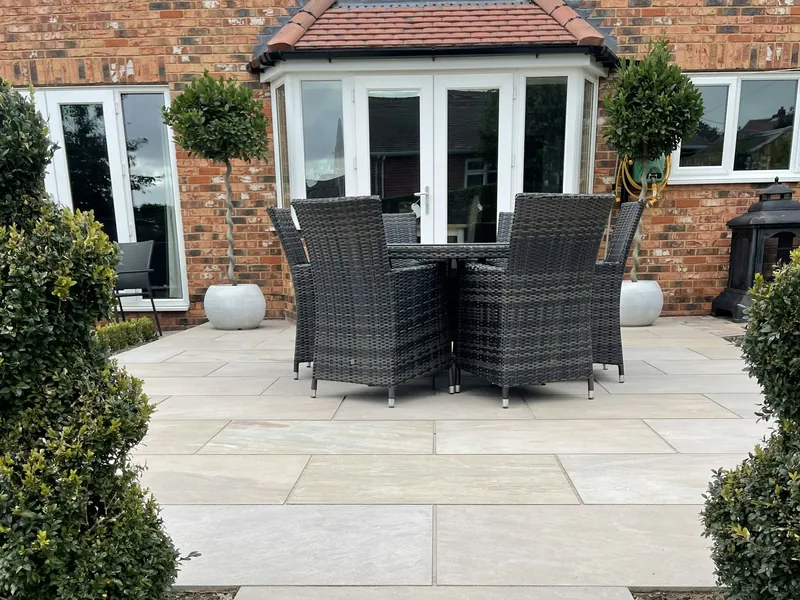
See your stone patio price before anyone visits
Pick the natural stone, rough m² footprint and groundwork needed. When you want a measured quote, your outline goes to a single patio builder in your county.