
Full wet mortar bed vs dot-and-dab in Ireland
Every natural stone flag in Ireland should sit on a continuous 35 to 50 mm full wet mortar bed (4:1 or 5:1 sharp grit sand to cement) with an SBR polymer slurry brushed onto the damp underside. Dot-and-dab (five blobs of mortar) leaves hollow voids that fill with winter rainwater, freeze, crack joints and pop slabs loose.
Why five-spot mortar blobs wreck natural stone patios in Irish winters, and how full-bed 4:1 mortar plus SBR slurry keeps flags solid.
Free, no obligation. One local builder prices it, not five.
- 35–50 mmfull wet mortar bed depth
- 4:1 / 5:1sharp grit sand to cement ratio
- 100%slab underside primed with SBR slurry
- Zero blobsdot-and-dab fails in Irish frost
Why dot-and-dab ruins natural stone patios in Ireland
Spot-bedding, known across Ireland as dot-and-dab, drops five trowel blobs of mortar onto the sub-base and taps a stone slab down onto the corners and middle. It saves an unethical crew half a bag of sand per square metre and looks flat on handover day.
By the second Irish winter, rainwater trickles down microscopic hairline cracks into the hollow spaces underneath. When temperatures dip below zero, trapped water expands, snapping the mortar bond, cracking open the pointing and turning slabs into rocking hazards. On porous Indian sandstone, moisture rising from the five blobs creates five ugly dark damp circles right through the stone.
Full wet mortar bed + SBR slurry
- Underside support
- 100% continuous contact across the entire stone
- Winter frost & rain
- Zero voids to collect freezing groundwater
- Damp staining
- Uniform moisture transfer across full slab face
- Joint longevity
- Zero flex keeps resin or mortar pointing intact
- BS 7533-101 compliance
- Compliant rigid natural stone laying standard
Dot-and-dab (five-spot bedding)
- Underside support
- Only 25% to 40% touched; hollow air pockets everywhere
- Winter frost & rain
- Water pools in cavities, freezes and pops flags loose
- Damp staining
- Dark ring-shaped damp stains and white efflorescence halos
- Joint longevity
- Micro-rocking cracks pointing within 1 to 2 winters
- BS 7533-101 compliance
- Explicitly prohibited under paving codes of practice
Price my patio
Four quick taps and our Irish m² price guide shows before we ask for a phone number. One local builder rings you, not five.
An Indian sandstone patio, 20 to 35 m², excavated from lawn on Clause 804: €3,650 to €5,200, excavated and laid.
How this m² guide is worked out
Every figure reflects going Irish supply-and-fit natural stone patio rates: digging out 200 to 250 mm of turf or old paving, laying geotextile membrane and 100 to 150 mm of compacted Clause 804 stone, bedding calibrated flags on a full 35 to 50 mm wet mortar bed with SBR slurry primer (never dot-and-dab) and pointing the joints. Narrow side-gate barrow access, deep retaining walls, soakaway crates and steep garden falls are priced after a builder checks levels on site.
The exact full-bed wet mortar and SBR slurry method
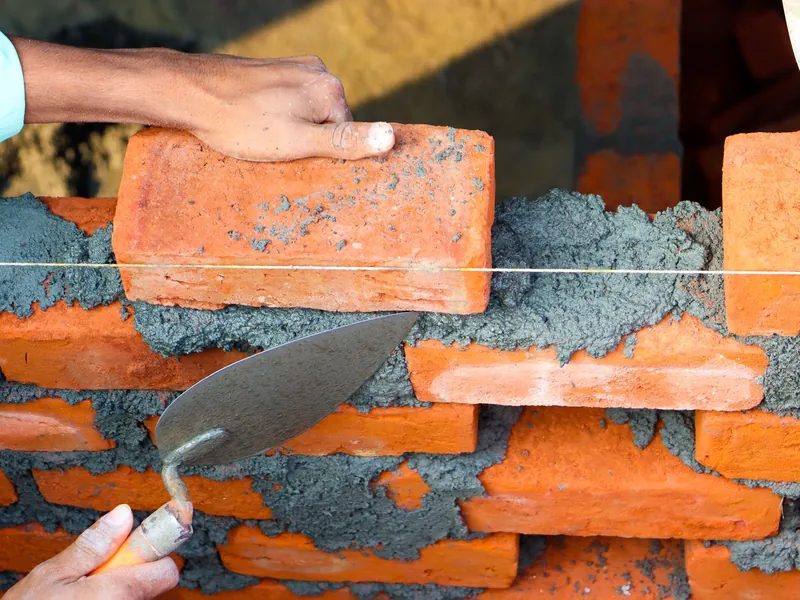
- Mix a workable 4:1 or 5:1 sharp grit sand and cement bed. Use washed sharp concreting grit sand, never soft plastering or building sand, mixed moist enough to ripple cleanly under a trowel without turning soupy.
- Spread a continuous 35 to 50 mm bed over compacted Clause 804. Ripple the surface lightly with the trowel edge so air escapes when the slab settles.
- Brush SBR polymer slurry onto every damp slab back. Combine SBR bonding emulsion with cement (or pre-blended priming mortar) into a thick slurry and coat 100% of the stone underside immediately before lowering.
- Tap down with a rubber mallet to string lines at 1:60 fall. Check every edge for lippage and wipe stray mortar smears off the stone face at once with a clean wet sponge.
Check what goes underneath the mortar in Clause 804 sub-base spec and how joints finish in resin vs mortar pointing.
Related patio guides
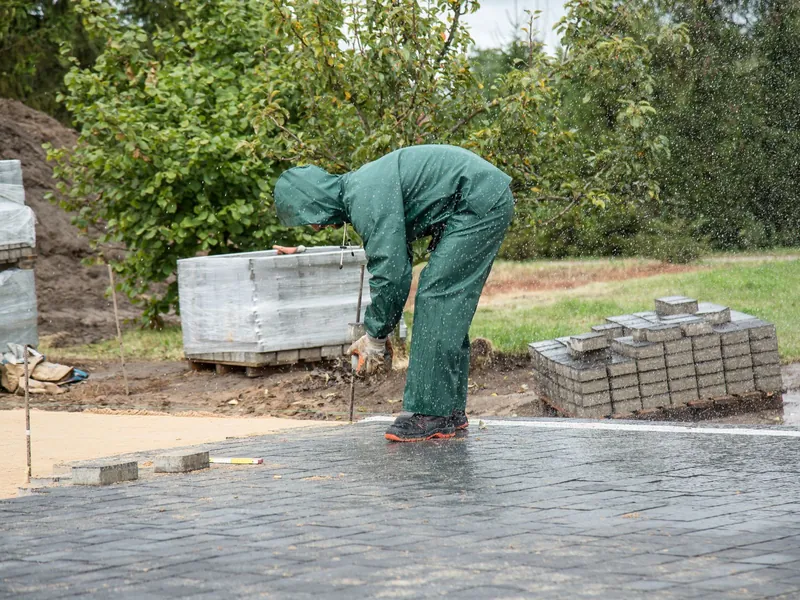 Clause 804 sub-base spec200 to 250 mm excavation, geotextile membrane and compacted Clause 804 stone.
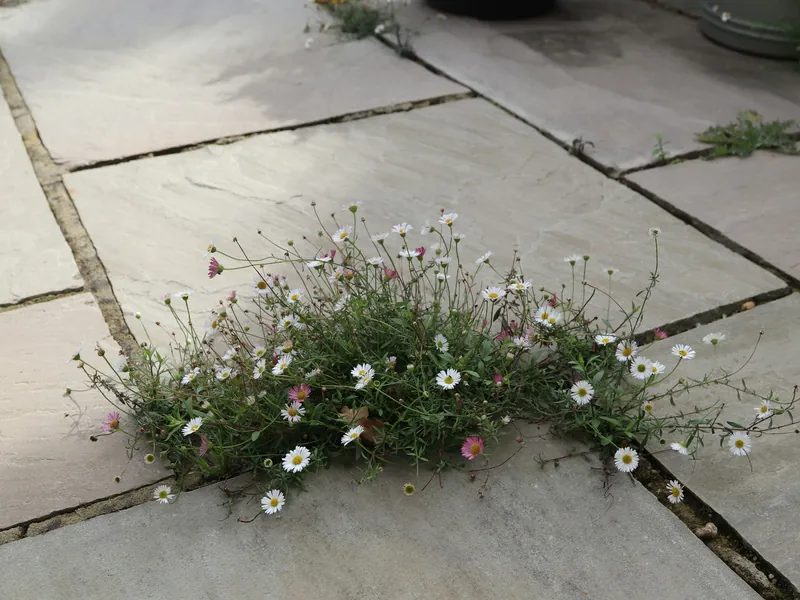 Resin vs mortar pointingPermeable sweep-in resin joints versus traditional struck wet sand-cement mortar.
 Drainage falls, DPC & ACO1:60 fall away from walls, 150 mm DPC step and concrete-haunched threshold drains.
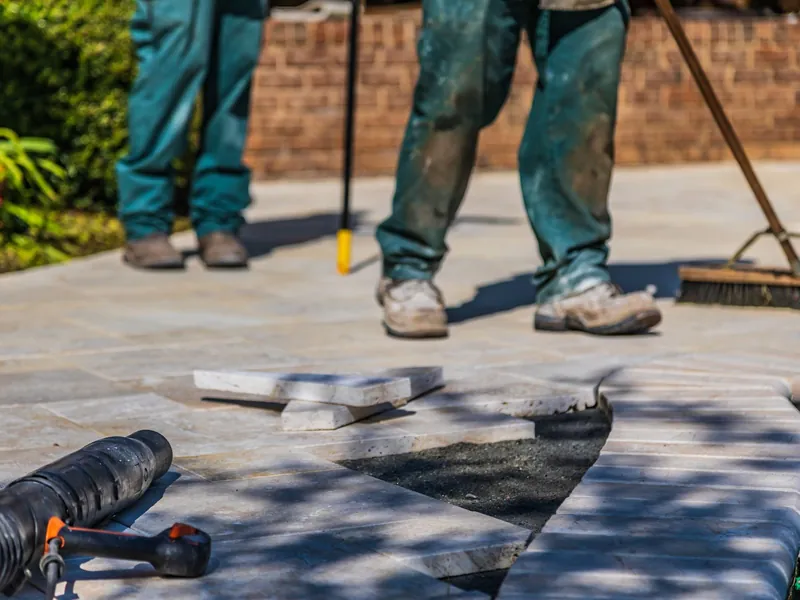 Extensions & re-pointingRaking failed mortar, extending old stone terraces and fixing rocking slabs.
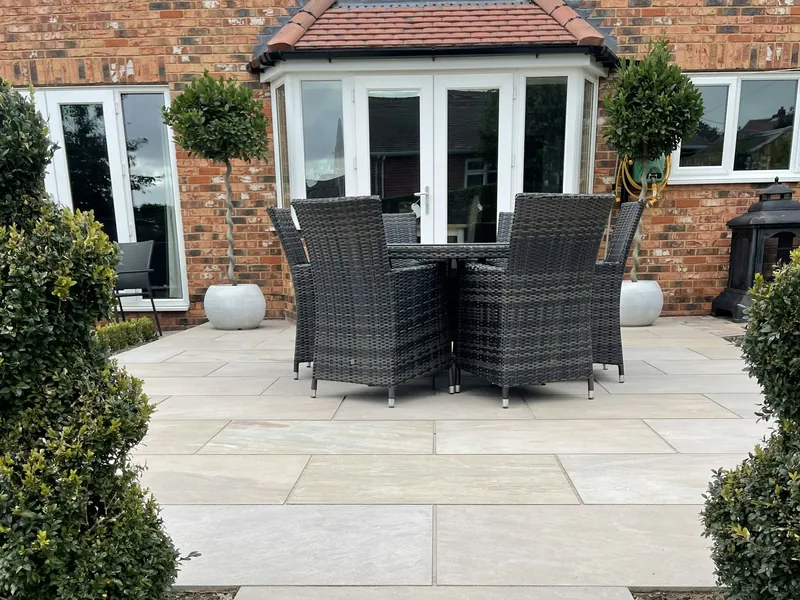 Indian sandstone patiosKandla grey, autumn brown and mint calibrated flags laid on full mortar beds.
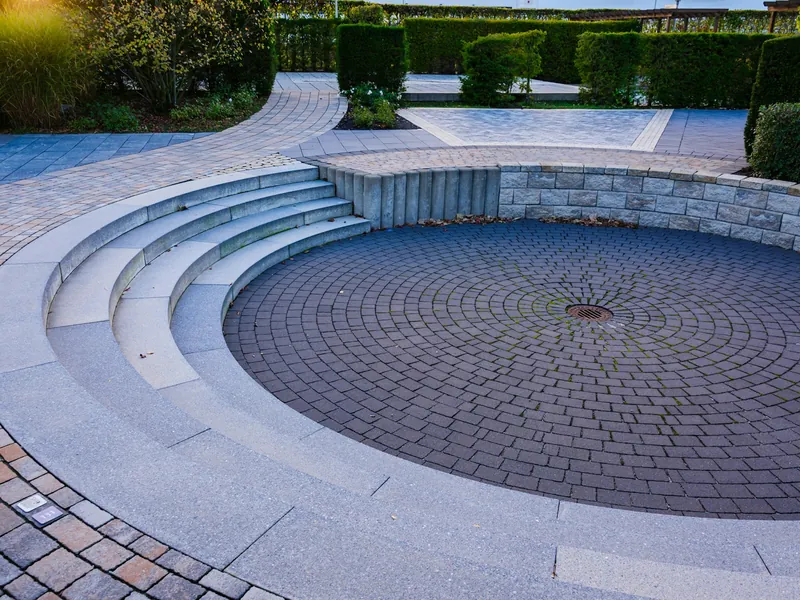 Flamed granite patiosSilver, yellow and dark flamed granite paving with high wet-foot grip.
Common patio questions in Ireland
How can I tell if my patio builder is using dot-and-dab while they work?
Watch one slab go down. A full wet bed covers the entire footprint smoothly before the flag lands and mortar squeezes evenly around the perimeter edges. Five mounds of mortar with bare stone visible between them means dot-and-dab.
What does SBR primer slurry actually do?
SBR (Styrene-Butadiene Rubber) polymer slurry acts as a waterproof chemical bridge between dense stone backs and sand-cement mortar. Without it, sawn granite, calibrated sandstone and dense limestone frequently delaminate in frost.
Why does efflorescence appear on new sandstone patios?
Efflorescence is white water-soluble salt drawn out of mortar or sub-base stone as moisture evaporates. Using low-alkali washed grit sand, full continuous bedding and proper 1:60 drainage falls keeps efflorescence minimal.
Can a dot-and-dab patio be fixed just by re-pointing?
No. Fresh pointing cannot hold rocking flags suspended over air pockets. Once spot-bedded slabs loosen, the only lasting repair is lifting the stone, cleaning the backs and re-laying on a full wet mortar bed.
Every natural stone patio guide and county page
Natural stone patios
Groundworks & Irish specs
See your stone patio price before anyone visits
Pick the natural stone, rough m² footprint and groundwork needed. When you want a measured quote, your outline goes to a single patio builder in your county.